
Winner, 2025 Outstanding Published Book Award, ASA Section on Altruism, Morality, and Social Solidarity
“A New Movement Aims to Remake Evangelicals’ Relationship to Politics.” The Washington Post.
“Markofski’s ethnography on multicultural evangelicalism is much needed, deeply nuanced, and highly accessible. A must-read for anyone interested in the intersection of race, politics, and evangelicals in America.” — John Inazu, Sally D. Danforth Distinguished Professor of Law and Religion, Washington University in St. Louis
“Markofski has written an ambitious and wide-ranging book mapping new terrain in the study of American evangelicalism and marking future directions for that broad religious movement so critical to American and global society. The book’s compelling argument will matter for the future of evangelical Christianity, for the future of democracy, and for how we understand ‘public religion’ generally. We need this book for meeting the current historical moment.” — Richard L. Wood, President, Institute for Advanced Catholic Studies, USC
“Markofski shows his ethnographic chops again and again … Humility—both intellectual and spiritual—is an important part of both Markofski’s normative project and empirical argument, and so the work of humility is a connecting thread between the body chapters and the more extensive theoretical chapters that close the book. … Markofski makes a convincing case that ethical democracy is our only path forward, and that doing ethical democracy requires commitment to communities of practice. He makes an even more impressive case that such practitioners—MAGA statistics duly noted—can very much include Evangelicals.” — Jeffrey Guhin, Review of Religious Research
“This may be the most important book in years on US evangelical Christianity, both for scholars concerned about anti-democratic trends and for students personally committed to evangelical religion. More broadly, this book will shape future conversations regarding public religion in the United States and globally, particularly the role religion can play in the defense and deepening of democracy.” — Social Forces
“In Good News, Markofski compellingly documents the on-the-ground work that a wide variety of “multicultural evangelicals” are doing to promote…“ethical democracy.” … Markofski’s deep focus on the intricacies of the lived theologies of his research subjects suggests that this book has a larger potential audience than sociologists who study religion and politics. … Christians who long for a more equitable world will find no shortage of inspiring models for how to understand and actualize the connection between faith and politics within the book’s pages. As such, while I can certainly see this book being read in a graduate class on the sociology of religion or politics, I can just as easily imagine it being read in theology programs, divinity schools, or even in churches interested in confronting issues such as racism and poverty. … Markofski states that his case studies “ought to be of particular interest to those concerned about the future of ethical democracy in America” (p. 42). I wholeheartedly concur.” — American Journal of Sociology
Good News for Common Goods: Multicultural Evangelicalism and Ethical Democracy in America
(Oxford University Press, 2023)
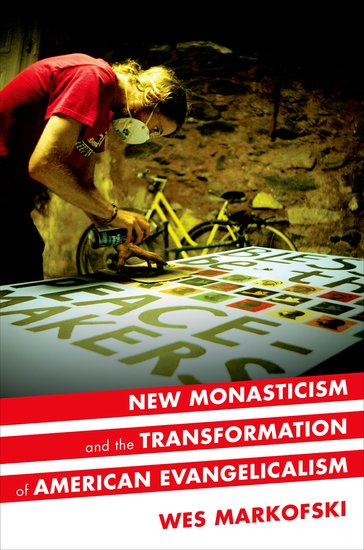
“For over three decades, the political leaders of the Christian Right have presented evangelical Protestantism as a static monolith and secular observers have eagerly ratified this picture. Drawing on a half-decade of ethnographic observation and the social theory of Pierre Bourdieu, Wes Markofski shatters this portrait to reveal the internal fault-lines within the evangelical ‘field’ and the ongoing conflicts that are radically reshaping it. Along the way, he provides an intimate portrait of the most dynamic element in contemporary evangelicalism: ‘the new urban monastics.’ Evangelical monastics, you say? Read on.” — Philip Gorski, Frederick and Laura Goff Professor of Sociology, Yale University
“Markofski’s profound contribution is to demonstrate how American evangelicalism continues to innovate and evolve from within. Scholars studying evangelicalism and those interested in theory will find the discussion of the reproduction and transformation of the subculture especially compelling.” – Sociology of Religion
“Through his detailed observations and lively prose, readers will encounter the art galleries, food pantries, homes, and pubs where the new monastics congregate. They will also encounter a sophisticated theoretical argument. … Markofski provides the most satisfying map of evangelicalism to appear in years.” – Journal of the American Academy of Religion
“Wes Markofski’s new book on the “new monastic” movement within American evangelicalism is significant. It offers the most thoroughgoing application of Bourdieusian field theory to any religious group yet published by a social scientist. … Markofski’s writing is lucid and his analysis is compelling.” – Journal for the Scientific Study of Religion
“New Monasticism is an important addition to the sociology of religion.” – American Journal of Sociology
New Monasticism and the Transformation of American Evangelicalism (Oxford University Press, 2015)
 Wes Markofski